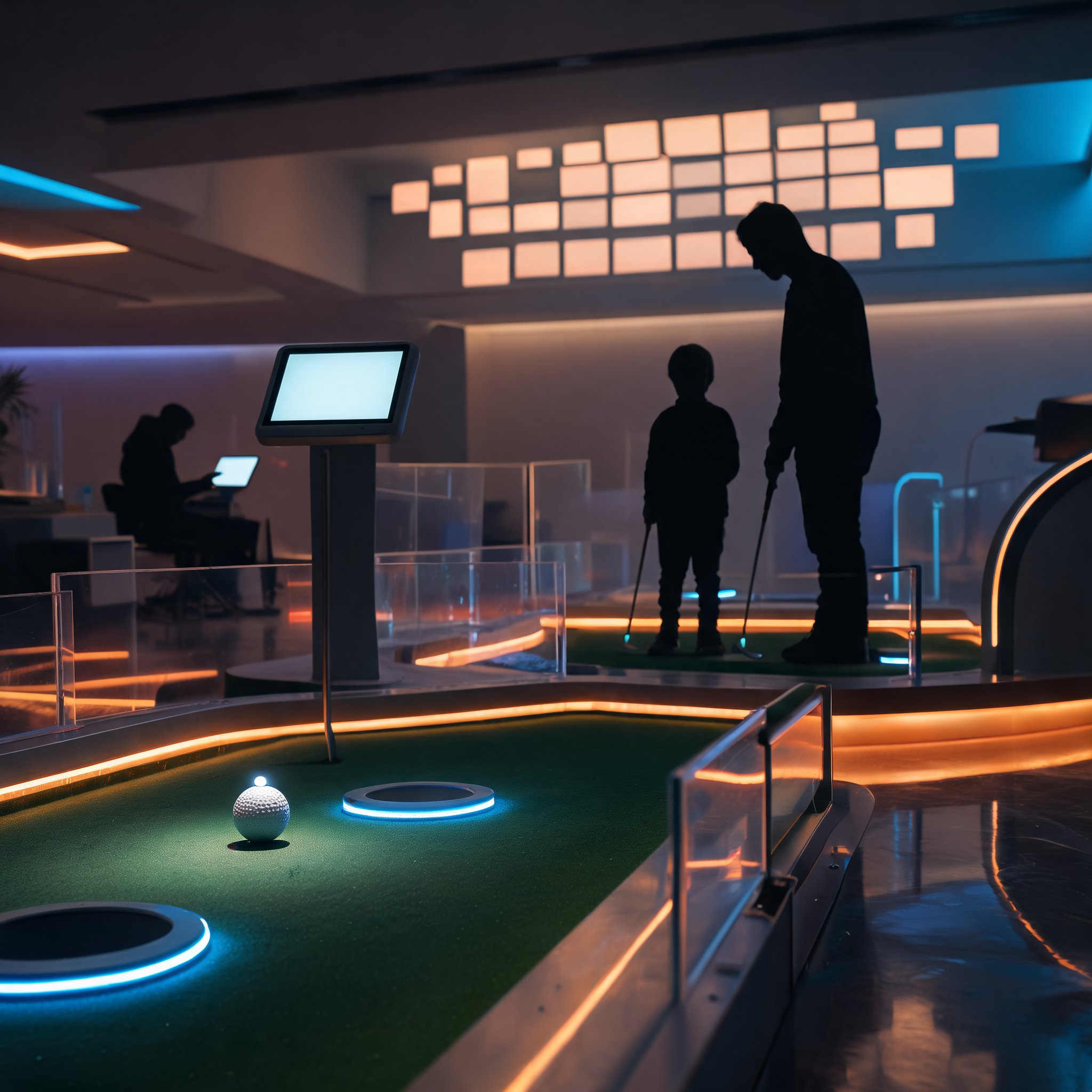
Mini golf is a familiar leisure format. Holovis is using that familiarity as the entry point for 360Golf, a system that adds automated scoring, game layers and operational analytics to the traditional putting experience. The company positions it not as a single course product but as a connected platform that can be retrofitted, specified from a catalogue or built as a custom attraction.
A familiar game with an instrumented core
At the centre of 360Golf is automatic scoring. Smart balls, tees and cups work with the HoloTrac system, removing paper scorecards and providing a consistent referee during competitive play. Visitors can register, collect an assigned ball and begin without a long explanation or heavy staff involvement. That simplicity matters because mini golf already has broad recognition; the technology is meant to sit on top of the format rather than replace what attracts people to it.
Holovis says the system is designed to appeal across age groups, from families to young adult competitive socialising groups and corporate bookings. The commercial argument is that a familiar activity can become a stronger anchor for a venue while remaining easy to operate.
Gamification creates reasons to return
Automated scoring is only the base layer. 360Golf adds SuperShots that offer alternative ways to earn points, Triumphs that present awards and unlock challenges, plus bonuses, on-course games, player accounts, achievements, leaderboards and video celebrations. These features give players more to compare and celebrate at the end of a round, and they create a record that can follow a visitor across repeat visits.
The retention case rests on this combination: the physical course provides the social occasion, while the digital layer gives players a reason to replay, improve and compete again. Holovis also links those interactions to its DeepSmarts analytics engine, which is intended to show operators how guests are using the venue and where operations might be adjusted.
Analytics move the product into operations
DeepSmarts is presented as an operator tool rather than a player-facing gimmick. Holovis says it can support decisions on uptime, player behaviour, seasonality and operational changes, and it can be offered as an additional service. The system is designed to increase dwell time and secondary spending, including food and beverage revenue, with capacity cited at up to 80 people per hour per course.
Remote diagnostics are part of the same operational layer. If a venue reports an unusual problem, the company says its team can review the course data and help identify the issue. 360Golf is also designed for straightforward maintenance, with repairable hardware intended to extend service life. These are company claims about the platform’s capabilities; the actual return will depend on site layout, pricing, staffing and how well the venue converts players into food and beverage customers.
One system, several installation models
The platform is offered in formats that range from a technology-only retrofit for an existing mini golf attraction to catalogue holes and fully bespoke course development. Holovis estimates that tech-only deployments can be installed in about six to eight weeks, catalogue holes in eight to 12 weeks, and custom courses in six months or more.
That range explains how 360Golf can serve different operators without changing its core scoring and game system. A smaller venue can use a more cost-effective course design while retaining automated scoring and replayable game features. A multi-site operator can use the same technology base to maintain consistency and then vary theming, layout or branding across locations. Holovis cites Saudi Entertainment Ventures as an example of a client seeking consistency across sites.
The custom end of the offer is illustrated by the Top 9 course at Netflix House, an IP-led installation with custom holes and interactive elements tied to titles including One Piece, Squid Game and Floor is Lava. Custom work also has to meet physical conditions. For Norwegian Cruise Line, 360Golf delivered four Tee Time installations using marine-grade hardware, including rugged cups and tees and specialist screens, so the same scoring and play pattern could work at sea. At Butlin's PLAYXPERIENCE in Bognor Regis, a £15m indoor activity centre opened in 2024 with three nine-hole 360Golf courses: a neon-glow course, a Las Vegas-themed challenge and a wheelchair-accessible music-themed course.
Holovis reports that the Butlin's tech-putt attraction has reached 5,000 players in a busy week and about £40,000 in weekly revenue. Those figures are useful as an operator example, but they are presented by the supplier and should not be treated as a guaranteed performance benchmark for other sites.
Inclusive design and repeat visitation
The Butlin's project also shows where physical design affects accessibility. Holovis says it considered right- and left-handed play, putter sizes for taller guests, wheelchair access close to or onto the course, reachable tees and spacing between holes to reduce crowding and safety hazards. At Lucky Duck in Norway, a custom course gives each hole two play routes, adding variety without requiring a larger footprint.
For multi-site clients, the value is as much organisational as experiential. A common technology base allows an operator to standardise scoring and gameplay while adapting the creative layer. That can support repeat visitation across a group, though it also requires the operator to manage course presentation and guest flow consistently.
What operators still have to prove
360Golf is moving into a crowded competitive socialising market. Holovis argues that mini golf’s accessibility gives it an advantage over concepts that need more explanation, and that the platform can serve families, young adults, corporate groups and other audiences. The company is also exploring adjacencies, including an integration with Roxy Leisure to add stroke-counting technology to crazy pool tables, and says it wants to apply its technology to other sports.
Those extensions suggest a broader ambition, but the near-term case remains venue-specific. Operators need to assess their space, audience and commercial model before choosing a retrofit, catalogue course or custom build. Holovis describes the offer as turnkey, not simply the purchase of a course, and says the starting conversation should cover venue restrictions, target customers and the revenue plan.
360Golf is scheduled to appear at the Land Leisure & Tourism Show at NEC Birmingham on 4-5 November and at IAAPA Expo in Orlando on 16-20 November, where Holovis will exhibit at booth S448. The product’s central proposition is clear: make a familiar game easier to score, more social to replay and more measurable to operate. Whether that produces durable returns depends on execution at each site.