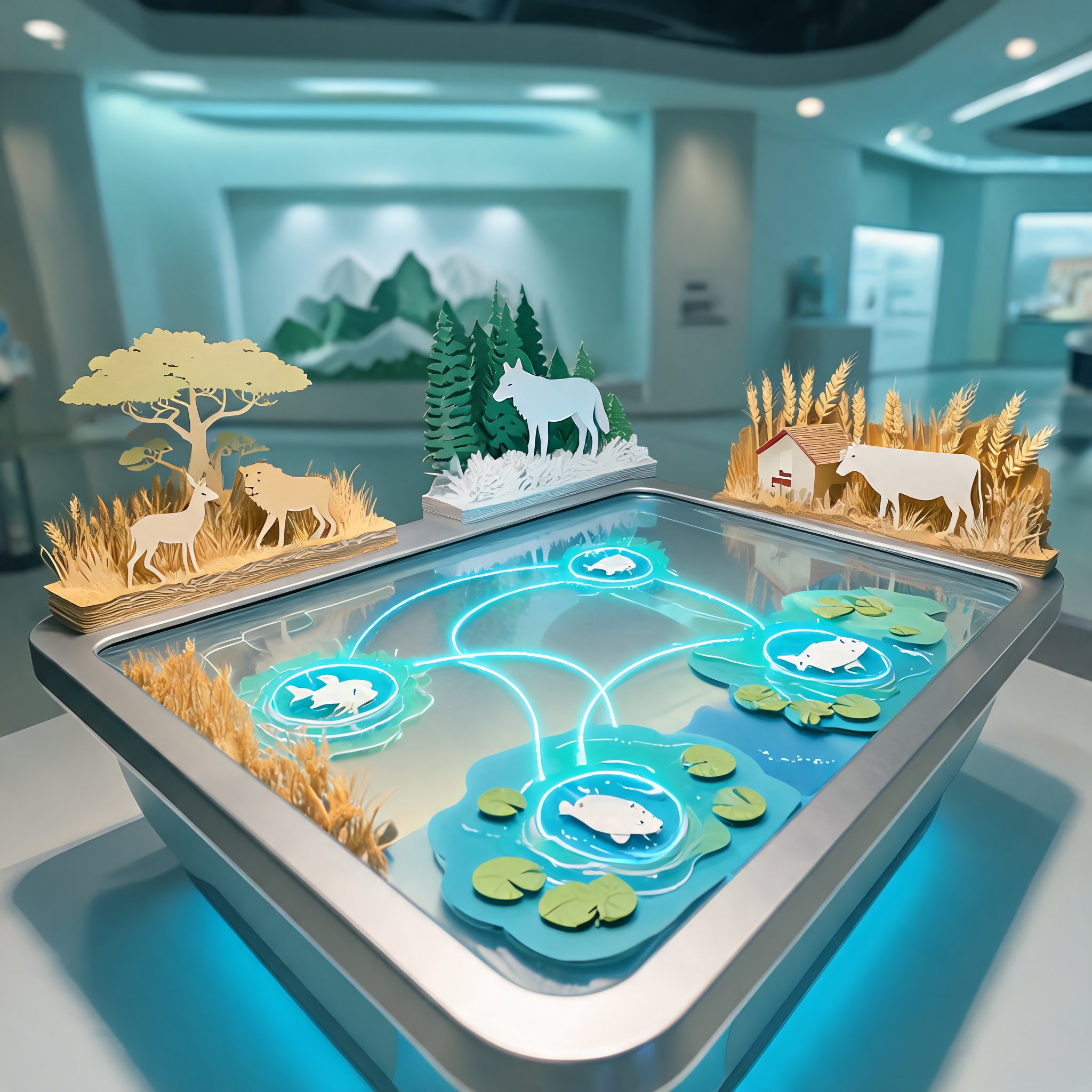
EcoWeb, an interactive ecological simulation from Lutra Interactive AB, gives visitors a hands-on way to explore how ecosystems respond when species are added or removed. Instead of presenting biodiversity as a count of species, the exhibit shows the connections between organisms and lets changes cascade through a food web. Removing a predator, for example, may affect herbivores and plants, while losing one species can produce unexpected consequences elsewhere in the network.
The project is intended to make indirect ecological effects visible. Traditional exhibits, diagrams and lists of threatened species can explain that biodiversity matters, but they have difficulty showing how those relationships work. EcoWeb combines ecological science, dynamic simulation and playful interaction to turn that complexity into an experience visitors can test for themselves.
A model built on published ecology
EcoWeb uses empirical food-web data drawn from published ecological research, systematic literature reviews and species occurrence data. Its model includes both bottom-up and top-down effects, so a change can propagate through the network rather than affecting only the species directly connected to it. This approach avoids simplified or fictional ecosystems and keeps the simulation grounded in real ecological information.
Progressive complexity for visitors
Visitors meet the system in stages. They begin with simple three-species food chains and explore what happens when a species is added or removed. They then move on to larger food webs, different types and strengths of ecological interactions, and eventually complete networks containing more than 100 species and over 1,000 interactions. Users can select individual species to reveal their connections and explore threatened species. In the Swedish forest ecosystem, they can move from recently cleared land to old-growth forest and see how both biodiversity and the network itself change.
Four contrasting ecosystems
The current version brings four ecosystems to life: the Serengeti savanna, the Swedish boreal forest, an agricultural landscape and Lake Bolmen, one of Sweden's largest lakes. The same underlying concept applies across all four while retaining locally relevant species, data and environmental challenges. That structure allows the exhibit to address different ecological contexts without changing the basic model of interconnected species.
From prototype to public use
Designed with scientists and educators, EcoWeb has moved beyond the prototype stage. It has been deployed as a touchscreen experience at Swedish science centres including Universeum in Gothenburg, Curiosum in Umeå and Visualization Center C in Norrköping. It is also accessible through the web for WWF Sweden. Observations from these installations show visitors spending time exploring species and their connections. Use with school groups has generated discussion and reasoning about extinction, indirect effects and trophic cascades.
EcoWeb is positioned around biodiversity loss, one of the central sustainability challenges the project addresses. Protecting biodiversity requires more than knowing that species are disappearing; it requires understanding why those species matter and how ecosystems depend on the relationships between them. By letting people experiment with ecosystems, EcoWeb aims to make complex sustainability science tangible, memorable and engaging, creating a bridge between ecological research and public understanding.