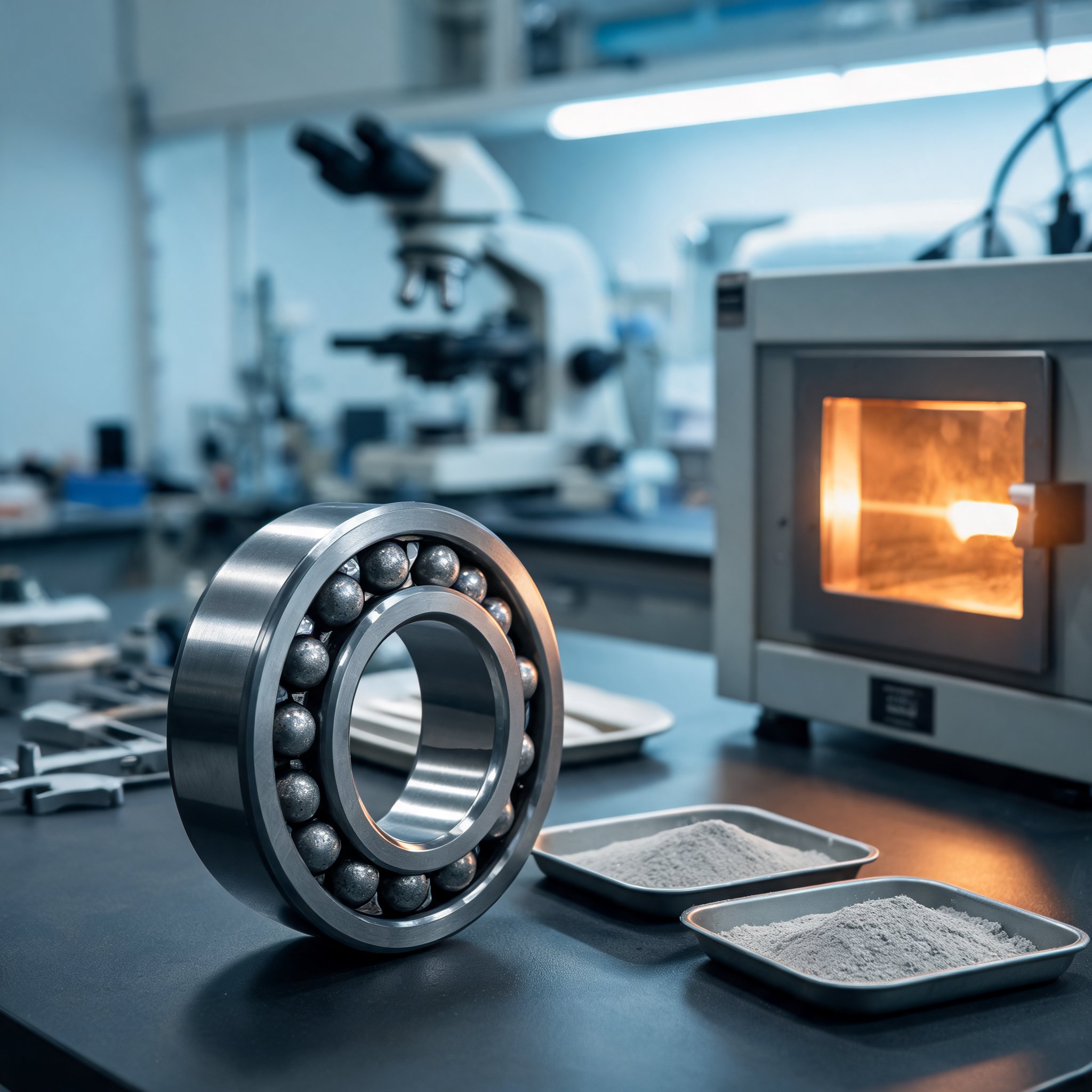
SKF has opened a Ceramic Process Laboratory (C-Pro Lab) at its research and development center in Houten, the Netherlands, giving the bearing maker an in-house facility that it says spans the entire ceramic manufacturing value chain, from raw material powder processing to the engineering of high-performance components.
The company positions the lab as a step toward broader global adoption of advanced hybrid bearing technology. Hybrid bearings combine high-grade steel rings with silicon nitride rolling elements, a pairing SKF says delivers stronger electrical insulation, lower weight and less friction than conventional all-steel bearings. Demand for such designs is described as rising quickly as industries shift toward electrification and higher energy efficiency.
End-to-end ceramic process under one roof
Annika Ölme, SKF's CTO and senior vice president for technology development, said ceramic and hybrid bearing technologies are essential enablers for clean and reliable rotation in next-generation industrial electrical applications. According to Ölme, the C-Pro Lab gives the company full command of the end-to-end ceramic process, which it expects to translate into faster innovation, better material performance and quicker commercialization of high-performance hybrid solutions for customers worldwide.
Operating as a global competence center within SKF's research and technology development organization, the laboratory brings powder formulation, compaction, sintering and surface finishing into a single setting. Co-locating those steps is intended to let researchers prototype new material compositions rapidly, optimize microstructures and raise process efficiency for high-volume manufacturing rather than for one-off samples.
Silicon nitride rolling elements are the ceramic component of the hybrid concept, paired with high-grade steel rings. Because performance depends on how the ceramic is formulated, compacted, sintered and finished, SKF says it needs control at each stage, which is what the co-located lab is designed to provide.
SKF describes the facility as state-of-the-art and as reinforcing its technology leadership across the complete ceramic manufacturing value chain. The scope runs from handling and processing raw material powders through to the engineering of finished parts, a breadth the company links to boosting global adoption of advanced hybrid bearing technology.
Target applications
SKF identifies industrial automation, aerospace and high-speed machinery as expanding sectors where hybrid ceramic bearings address critical operational problems. In high-speed electric motors, the ceramic rolling elements are used to prevent electrical erosion; the company also cites friction reductions of up to 50 percent and reliable operation at extreme temperatures in demanding environments, capabilities it ties to demand for electrification, energy efficiency and operational reliability.
The official opening brought together customers from railway, aerospace and drives alongside other stakeholders and H.E. Julius Liljeström, the Swedish Ambassador to the Netherlands. SKF presented the event as evidence of the close customer collaboration it relies on to advance industrial innovation and sustainable technology.